It’s not about his salary.
It’s not about the prospects.
And it’s definitely not about her emails.
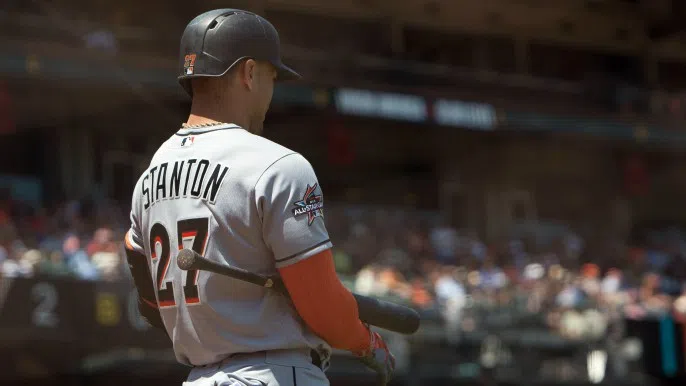
If the San Francisco Giants expect to land Miami Marlins’ slugger Giancarlo Stanton this winter, then eventually, they’ll have to make a hefty financial commitment, and part with a few of their top prospects. But before general manager Bobby Evans can press play on a potential deal, the Giants need to know whether Stanton would be willing to waive his no-trade clause.
On Thursday evening, Craig Mish of Sirius XM radio reported that Evans, vice president of baseball operations Brian Sabean, and Giants’ manager Bruce Bochy were in Los Angeles meeting with Stanton’s representatives, presumably to ascertain whether the 2017 National League MVP would consider playing in San Francisco, and likely to alleviate the potential concerns Stanton has about accepting a trade.
It’s not the final step of the process, to be sure, but it is a landmark development. Mish and several other prominent MLB reporters have considered the Giants the favorites to land Stanton, but that’s without knowing whether Stanton would even entertain the idea of leaving Miami for San Francisco. The Los Angeles Dodgers, Stanton’s hometown team, are widely considered his team of choice, but it’s unlikely the Giants’ rivals would be willing to take on enough of Stanton’s salary to convince the Marlins to swing a deal.
As a result, Stanton could be left with only a handful of suitors to choose from, and because the Giants have some of the deepest pockets in baseball, they’re high on the list of teams the Marlins are eager to do business with.
If Stanton’s representatives liked what they heard on Thursday evening, they’ll likely spend Friday pitching their client on the pros and cons of accepting a trade to the Giants. While there are surely concerns Stanton might still hold even if he was to accept a trade to San Francisco, the situation with Miami’s ownership (specifically its steadfast desire to cut payroll) is hardly desirable.
How should the Giants pitch Stanton on the idea of moving out West? I outlined four key selling points.
The “Legend” factor
Stanton is already one of the most popular players in baseball, and he’s playing in a market that doesn’t exactly embrace his team. In a year in which Stanton hit 59 home runs and drove in 132 runs, the Marlins finished 28th in attendance. The Giants, meanwhile, posted a 64-98 record, and ended the year with the third-highest attendance in baseball, easily surpassing 3,000,000 tickets sold while drawing an average of more than 40,000 per game.
Quite simply, the Giants put out an anemic product this season, yet fans still showed up to AT&T Park in droves. Though the franchise’s National League record sellout streak ended at 530 games in July, San Francisco packed the house and will do so again in 2018. If Stanton is on the roster, though, the demand for tickets will skyrocket, and the Giants should once again contend to lead the Major Leagues in attendance. San Francisco is a city that shows incredible loyalty to its superstars, and Stanton would be no exception.
Over the past 30 years, the Bay Area has established itself as a mecca for superstar talent, with players like Joe Montana, Steve Young and Jerry Rice captivating fans on the football field, and Steph Curry, Draymond Green and now Kevin Durant taking the world by storm on the basketball court. The stars who’ve called AT&T Park home, though, receive some of the warmest ovations in all of sports. Stanton has a relationship with Barry Bonds, his former hitting coach, who knows exactly what it’s like to receive the superstar treatment in San Francisco, and he’s played in All-Star Games and the World Baseball Classic with the beloved Buster Posey.
This year alone, the Giants celebrated the official retirements of Matt Cain and Ryan Vogelsong, two pitchers with sub .500 career records who received massive tributes.
There’s no shortage of players the Giants will celebrate from their golden era for years to come, but the acquisition of Stanton allows San Francisco an opportunity to extend its championship window, and contend for titles with one of the game’s ultra stars in his prime. The “Legend” factor is a major draw for athletes, and it’s the message the Giants should be selling the hardest.
The “Aberration” factor
“We’re not last place people.”
It’s a line Sabean used in the Giants’ end-of-season press conference, and it’s a line the current Giants’ regime will be judged for over the next two-to-three seasons. Evans, Sabean, Bochy and many of the team’s core players consider the 2017 season an aberration, and believe a few tweaks will make San Francisco capable of competing come 2018.
Why should Stanton believe them? Whether it’s a sound rationale or not, the Giants can point to their recent track record of success and attempt to pinpoint why their season spiraled out of control in the manner in which it did. Evans and Sabean can justify their belief that 2017 was an aberration by highlighting a roster that includes established veterans like Buster Posey, Brandon Crawford and Madison Bumgarner, and explain how Stanton would become the centerpiece of a team with enough supplementary pieces to spark an immediate turnaround.
The Giants can sell a pitching staff that includes Bumgarner, Johnny Cueto, Jeff Samardzija and Mark Melancon as the team’s foundation, and explain how Stanton’s presence would impact each hitter in the lineup. San Francisco can also outline its vision for the future, and explain how its new mission of finding younger, more athletic players will set the team up for success beyond 2020, when several of the team’s current players will have contracts that expire, or will be past the prime of their careers.
The “Commitment” factor
Stanton doesn’t have to worry about a team committing to him for the next decade, because the contract he signed three years ago will allow him to make $295 over the next 10 seasons. What the Marlins’ right fielder should be concerned about, though, is how a team plans to build around him.
The Giants are one of the few teams in baseball that consistently spend to win, and they can point to the payroll they’ve carried over each season in the last decade as an example of how San Francisco’s ownership will do what it takes to position the team for success on the field. San Francisco shells out money to keep its most successful players home (see Posey, Crawford, Brandon Belt), and isn’t afraid to make splashes in the free agent market to complement its home grown talent (see Cueto, Samardzija, Melancon).
While Stanton’s current team is working to cut its payroll down to $90 million before the start of the 2018 season, the Giants have proven they’re willing to spend beyond the luxury tax threshold in recent seasons to create a more competitive club. Though spending more money doesn’t necessarily lead to more on-field success, the Giants can alleviate any concerns Stanton has about the team’s future depth by committing to keeping their best players around Stanton for years to come.
The “Tax”/”Silicon Valley” factor
Call it the “Durant plan.”
When the Golden State Warriors acquired Durant last summer, the sales pitch included the opportunity for the Warriors to help their star make connections in Silicon Valley that would allow him to advance his business career and set him up for life after basketball. By leaving Oklahoma City, the team that could offer him the most money in free agency, Durant was willing to take a smaller salary to play in a state where his new salary would be taxed more.
Though Stanton will still be owed $295 million regardless of where he plays, ESPN’s Buster Olney reported Friday morning that Stanton would lose out on a significant chunk of cash by playing in California, as opposed to Florida.
For Giancarlo Stanton to move from the Marlins to a California team, there would be a major state tax increase. Some agents estimate it could cost Stanton in range of $25m-$27.5m over course of his 10-year deal. Marlins/trade partner could endeavor to offset this.
— Buster Olney (@Buster_ESPN) December 1, 2017
The Giants would be wise to take a page out of the Warriors’ playbook here, and attempt to entice their star with the promise of fostering Silicon Valley relationships and new business opportunities to help him make up for the money he’ll be handing over to the government. Though San Francisco’s ownership doesn’t have the aggressive Silicon Valley ties the Warriors’ owners, Joe Lacob and Peter Guber, do, it shouldn’t be hard to find avenues for Stanton to invest and grow his fortune.
Stanton is a mega-star much in the same way that Durant was before he arrived in the Bay Area, and even if he doesn’t possess the same business interest as the Warriors’ forward, it’s a pitch that should intrigue any athlete. While that type of sales point might not work on the free agent market for every player, specifically ones that sign shorter deals, a trade to San Francisco would set Stanton up to spend the next decade of his life in the Bay Area, and the Giants should attempt to play up this tie.